
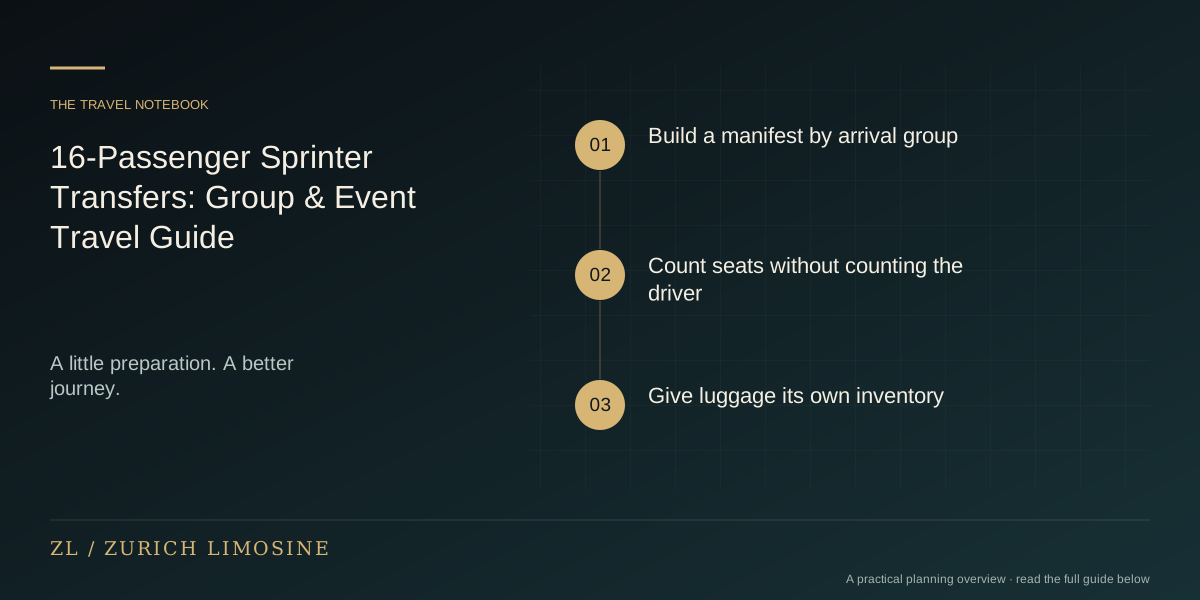
Build a manifest by arrival group
Start with the people who are actually travelling together. Record a lead name, total passengers, arrival flight or train, date and destination for each group. Where several flights are involved, keep them on separate lines until the transport team has checked whether the arrivals can share a vehicle. Avoid collecting passport details when a name and reachable coordinator are enough for the transport plan. Share the manifest through an appropriate private channel.
Count seats without counting the driver
A request for 16 passengers means 16 travellers in addition to the chauffeur. A Sprinter badge does not establish a seating layout: different passenger conversions have different arrangements. Ask the provider to confirm the actual passenger-seat count and whether the selected layout accommodates the whole group. If a passenger needs particular assistance or equipment, describe the practical requirement before the vehicle is allocated. Do not infer accessibility from the exterior photograph.
Give luggage its own inventory
Sixteen small backpacks and sixteen large suitcases are very different loads. List checked cases, cabin bags, sports equipment, pushchairs and presentation materials separately. Note any case that is unusually long or heavy. Ask whether the entire load travels in the passenger vehicle or needs another agreed arrangement. A published seat count should never be treated as a simultaneous promise about luggage. If the party changes, update both counts rather than only the headcount.
Create one meeting instruction for the group
Send the same confirmed pickup description to every passenger. Include the lead contact, a recognisable meeting location and the action to take if someone is delayed. The group leader should perform a headcount before boarding is considered complete. For arrivals split between terminals or buildings, agree whether passengers gather at one place or the itinerary includes several pickups. Those extra movements affect the schedule and should be agreed before travel.
Choose how to handle a late traveller
Decide in advance who may authorise waiting, a separate transfer or a changed departure. The organiser should not promise a fixed maximum waiting time unless the provider has agreed it. If one flight is delayed, the coordinator needs an updated arrival estimate and the team’s options, not an assumption that the original vehicle can wait indefinitely. Record the revised decision in the current itinerary and tell every affected subgroup.
Check the return as a new movement
For the return leg, confirm which passengers are still travelling, whether luggage has changed and where the vehicle can legally collect the group. A conference venue may have a different departure entrance from its arrival entrance. Assign a person to check the vehicle for left belongings after unloading. If the journey ends at an airport, keep the flight groups clear so bags and passengers are not delivered to the wrong agreed drop-off point.
Keep the shared information proportionate
A group organiser needs enough information to coordinate transport, but not every personal detail held by an event or travel agency. Use a lead passenger, subgroup counts and contact details relevant to the pickup. Share individual names only where they help the operation and keep the file away from public links. If a passenger needs a practical accommodation, describe what assistance or equipment is needed without circulating unnecessary health history. A smaller, current transport manifest is easier to use than a full conference registration export with unrelated fields.
Match the vehicle to the pickup location
Tell the team whether collection is at an airport, hotel driveway, narrow street or event venue. A larger vehicle may need a different agreed stopping point from a sedan. Ask the property or organiser for current instructions and send them before confirmation. If the vehicle cannot stop directly at the entrance, guests need a clear walking or local-transfer arrangement. Consider how luggage reaches the collection point and who helps organise it. Do not assume a building’s postal address identifies a suitable place for a group vehicle to wait or load.
Create a bag count that can be checked twice
Use a simple inventory the organiser can verify at pickup and unloading. Count the physical pieces, not just the number of travellers who say they have luggage. Note unusual items separately and ask passengers to identify their own bags. If two flights are being combined, keep each subgroup’s bag count until the entire party is assembled. At the destination, check that the inventory has arrived before releasing the vehicle. This practical check is especially useful when several black cases look similar or some passengers leave for different hotels.
Explain multiple destinations before accepting the quote
A group going to several hotels does not have one destination. List each property, its address and the number of passengers leaving there. Ask the team to review a sensible stop order and the effect on the schedule. Keep the luggage for each subgroup identifiable so unloading is straightforward. If the organiser wants to change the order on the day, contact the team for agreement. The published route between two towns does not automatically include a series of hotel stops, a sightseeing detour or an unplanned restaurant visit.
Plan for different return needs
Some delegates may return on an early flight while others remain for a later programme. Identify those movements separately and avoid promising that one vehicle can cover them without a reviewed itinerary. Ask each subgroup to confirm its departure date, airport, flight and luggage. Where a single common pickup is proposed, make sure passengers understand any waiting or onward arrangement. Assign a lead person to each movement, even if one organiser manages the whole event. The return plan should describe the travellers who actually leave, rather than copying the original arrival manifest.
Set a final review point
Agree when the organiser will send the current headcount, load and flight list for the team’s review. That review is a chance to resolve missing details before travel, not a guarantee that later changes can always be accommodated. Highlight amendments clearly: two additional cases, a replaced flight, a different hotel or a new collection time. Ask the team to confirm any change affecting the vehicle or price. Keep the accepted version with the person travelling so they can compare the practical arrangement with what was agreed.
Check the roster before moving
Use a passenger roster owned by the group organiser, with a simple count at each boarding point. Do not put passport numbers or sensitive personal details into transport notes. When travellers leave the group at different destinations, record the intended drop-off sequence and which luggage belongs to each stop. Recount after breaks, and keep the organiser’s reachable phone number with the chauffeur. A larger group benefits from one person confirming that everyone is ready to continue.
Compare your options
| Manifest field | Example format | Why it helps |
|---|---|---|
| Group | Delegates A · 8 passengers | Keeps an arrival party together |
| Arrival | Flight number · local date | Prevents mixing different travel days |
| Load | 8 cases · 4 cabin bags | Supports the vehicle assessment |
| Meeting | Confirmed area · coordinator number | Gives passengers one instruction |
| Return | Date · venue entrance · revised count | Avoids copying an outdated arrival plan |
Your travel checklist
- 16 passengers excludes the chauffeur
- Seat layout and luggage volume confirmed together
- One lead contact and a backup organiser
- Separate flight groups shown on the manifest
- Return headcount checked again
Questions about this journey
Does the Sprinter photo prove it has 16 passenger seats?+
No. The photo is a reference for the vehicle type. The requested 16-passenger configuration, excluding the driver, must be confirmed for the assigned vehicle.
Can we add a seventeenth passenger?+
Tell the team before travel so a different configuration or another vehicle can be considered. Never assume an extra person can travel without an allocated passenger seat.
Should everyone send their own request?+
For one coordinated group journey, one organiser can submit the complete itinerary. Separate requests may be useful for independent journeys, but identify related groups clearly.